00Progress so far — what's proven
A running record of what's actually been tested, so progress is visible and nothing gets re-litigated.
✓ POC PROVEN END-TO-END — 26–27 June 2026. Trigger → BLE event → live reaction on a real iPhone 17 Pro Max and a Samsung Galaxy, across all four states (Watch · Shield · Emergency · Cancel) with a continuous heartbeat. The core concept is de-risked — what remains is the physical-trigger hardware and polish.
ProofGuard-POC and connects to both the iPhone 17 Pro Max and a Samsung Galaxy — discover, connect, subscribe to GATT, live heartbeat. The old Tuya-app / iPhone-17 pairing gap is moot — we no longer use the Tuya path.WATCH / SHIELD / EMERGENCY / CANCEL and the app reacts instantly — the pulsing gold-shield state card changes colour and the event log updates. Captured in live screenshots on the iPhone 17 Pro Max (27 June).01The three-state model
We're building around three escalating states, not a single panic button. This is what separates ProofGuard from a blunt alarm — it supports the ambiguity of "something feels wrong but I'm not yet in danger."
IDLE → MONITORING
Once the device connects, the app shows a calm pulsing green "Monitoring" shield — quietly watching over you. No session running; a single press reports battery / status.
WATCH — silent
Discreet evidence capture begins: GPS trail, timestamp, optional audio/video. Nobody nearby knows. Fully reversible.
SHIELD — escalated, still silent
Higher-frequency GPS, live location shared with a trusted contact, check-in countdown. The "someone's walking behind me" state.
EMERGENCY — unmistakable
Pull the pin: 130dB siren, flashing LEDs, high-frequency GPS, contacts alerted, recording continues.
Trigger mapping under test: single press = status · double press = Watch · long press 3s = Shield · pull-pin = Emergency. The UX principle that must hold: Emergency has to feel physically different from Watch — Watch is discreet and reversible; Emergency is irreversible and loud.
02The bench rig & test plan
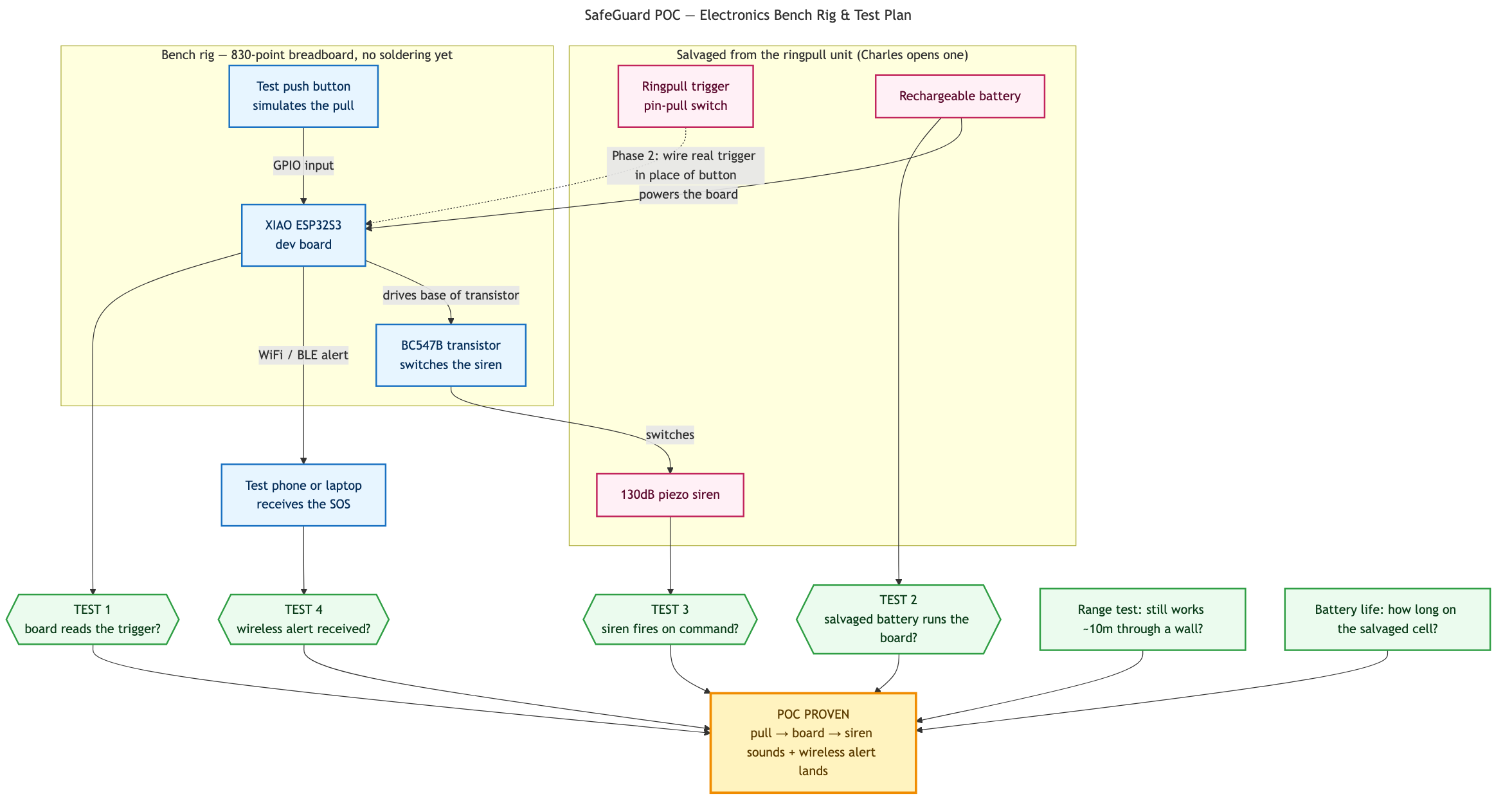
This is the rig diagram already shared with Aaron and Charles. The four tests plus the two field checks are the definition of "POC proven."
What you can do solo this week — no soldering
On a solderless breadboard with a tactile button standing in for the pull-pin, four of the six checks are reachable on your own:
POC proven = pull-pin (or button) → siren sounds + wireless alert lands on a locked iPhone in the next room. Hit that, and the concept is de-risked enough to ask for the next tranche.
03Build sequence
Five incremental steps. Each one only starts when the previous is proven — don't chase polish.
- Button-only BLE trigger — tactile button on breadboard → BLE event → phone sees it.
- Mode mapping — implement
WATCH_START,SHIELD_START,EMERGENCY_START,CANCEL. - Pull-pin integration — after a continuity test, wire the donor pull-pin to a GPIO; removal →
EMERGENCY_START. - Alarm integration — add the donor piezo / a buzzer; pull-pin → audible alarm and BLE event together.
- Battery test — run from the LiPo and measure idle vs alarm current draw.
Board decision — moved to the ESP32-C3. The dev board to hand is the XIAO ESP32-S3 Sense (camera + mic + microSD). For the shipping wearable we've dropped to the bare ESP32-C3: it keeps the BLE + button GPIO we actually use and deliberately has no camera or microphone — a privacy / GDPR win on a personal-safety device, lower power draw, and far cheaper (~£3/unit · 4 for £12 vs ~£11).
Evidence capture (audio / video) lives on the phone, where it belongs — so the device never needs a camera or mic. The firmware is a quick recompile for the C3 target when the boards arrive.
04BLE event schema (cloud-free)
Device is the BLE peripheral/advertiser; the phone is the scanner. For POC, simple advertisements beat a permanent connection — and crucially this removes the Tuya Cloud dependency.
| Code | Event | Meaning |
|---|---|---|
0x01 | WATCH_START | Silent Watch mode begins |
0x02 | SHIELD_START | Escalate to Shield |
0x03 | EMERGENCY_START | Pull-pin / panic action |
0x04 | CANCEL | User cancels the session |
0x05 | STATUS | Battery / heartbeat |
0x06–07 | PIN_INSERTED / REMOVED | Hardware diagnostic |
Latency target: POC ≤ 3s to detect a BLE event. MVP: median <1s, with documented iOS/Android background behaviour. Evidence principle: capture starts before the incident — a timestamped GPS + event timeline, stored locally and encrypted, exported only on escalation.
05POC bill of materials
| Item | Qty | Approx | Notes |
|---|---|---|---|
| XIAO ESP32-S3 / Sense | 1 | £11–14 | Core BLE board |
| Breadboard + jumpers | 1 | ~£6 | Likely already have |
| Tactile buttons | 2–5 | £1–3 | Mode triggers |
| Donor alarm | 1 | owned | Pull-pin, piezo, enclosure, LiPo |
| BC547B transistor | 1 | pennies | Switches the piezo siren |
| Multimeter | 1 | owned/borrow | Essential for continuity + current |
Your Elegoo kit (when found) covers the breadboard, jumpers, buttons, transistors and LEDs — that's the whole solderless side of the rig in one box.
06Getting hands-on help — Plan B
The plan for the physical build is a hands-on "MacGyver" frankenbuild with the local Men's Shed — wiring the button press and emergency pull-pin and salvaging the donor parts. We line up parallel options so the build never stalls on one person.
Men's Shed (primary)
A room full of practical hands, tools and a workbench. The plan: experiment with the button press and emergency pull on a salvaged-parts frankenbuild. Sociable, low-cost, and exactly the right setting for a scrappy bench prototype. (See the Men's Shed worksheet.)
Charles (secondary)
Soldering + production-line experience. The Elsenham meet he mentioned is worth attending regardless. Keep him in the loop, but don't make him a single point of failure.
Elsenham maker meet
The meet Charles mentioned — go even if he can't. Local tinkerers in one room is exactly the network this needs.
Local Facebook groups
Post in Bishop's Stortford / Stansted / Elsenham community + maker groups: "looking for an electronics tinkerer for a small BLE prototype." Low cost, surprisingly effective.
Makerspace
Fallback with tools, soldering stations and people who do this for fun. Day passes are cheap and unblock the soldering steps fast.
The point: Tests 1, 4, range and background are all solderable-free and doable solo now. Help is only needed for the donor-harvest / siren-driver steps — so the project keeps moving while you find the right hands.
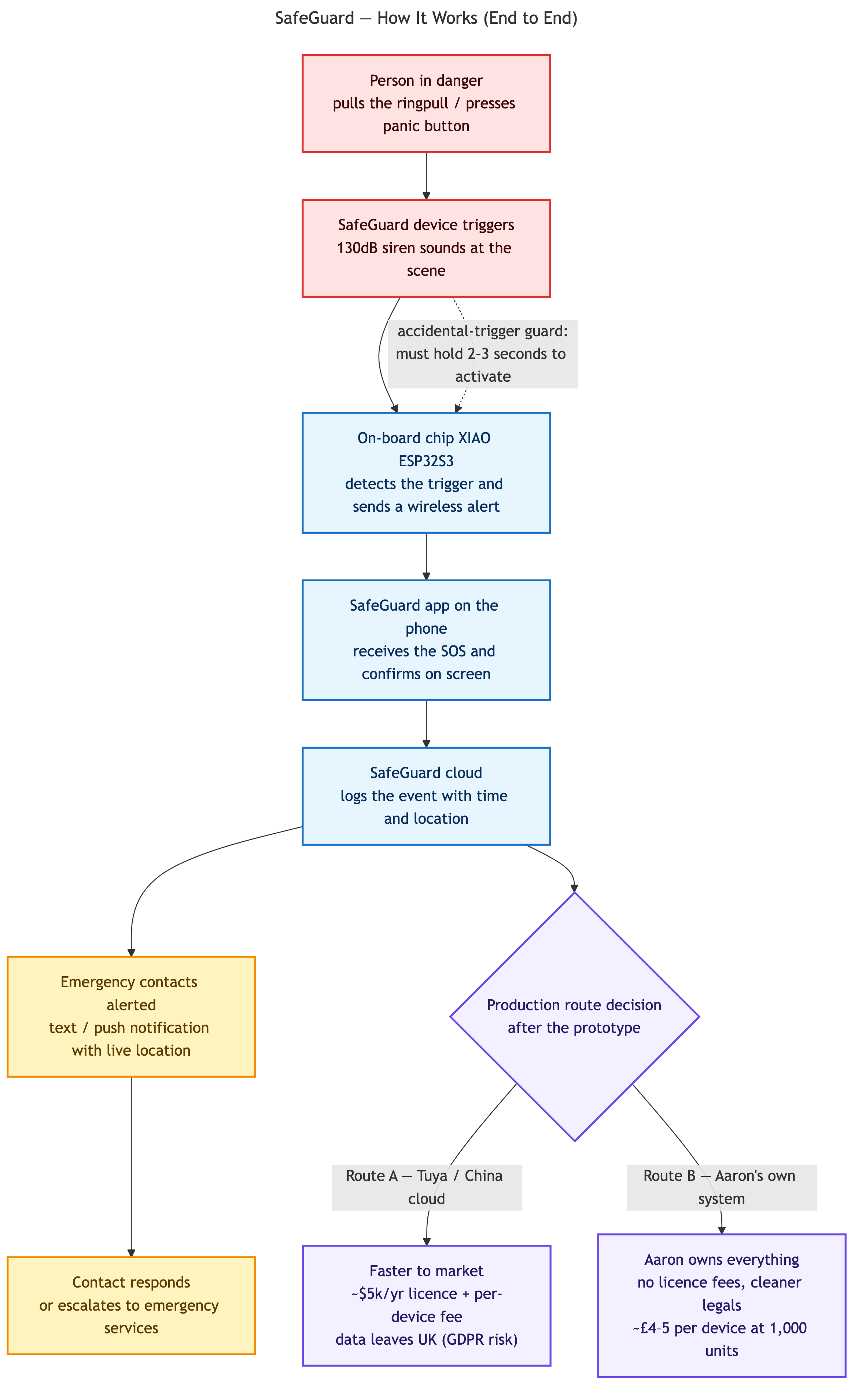
07How it all fits together
08Above & beyond the bench POC
The brief was to prove the device. Alongside that, the engagement has stood up the brand, product and commercial scaffolding a real launch needs — so the moment the hardware is signed off, everything around it is already in place.
Brand & name
ProofGuard — chosen from a shortlist, with the positioning baked into the name: Proof (the evidence loop) + Guard (deterrence).
Domain & email
getproofguard.com secured, with email routing and transactional email wired up — ready for a waitlist / beta capture.
Live web presence
Multiple live sites on Cloudflare: this intel dashboard, a sales / copy-arena page, and a product site — all real URLs, not mock-ups.
iOS app — on a real iPhone
Native iOS app, signed under a paid Apple Developer account and installed on the iPhone 17 Pro Max, all four states verified live.
Android app — on a real Samsung
Native Android app installed and verified on a Samsung Galaxy — both platforms demo-ready, not just iOS.
Pulsing gold-shield UI
A custom animated state card — green Monitoring → amber Watch → orange Shield → red Emergency — built natively on both apps, breathing faster as urgency rises.
Launch promo assets
AI-generated gold-shield "aura" promo video renders, ready to seed the launch story.
Market intelligence
Full UK competitor landscape + five unoccupied positioning territories (see Market Intel) — the strategic case, not just the gadget.
24/7 monitoring research
A ranked shortlist of UK ARC / telecare partners for a future "Guardian" monitored tier — a second recurring-revenue line (see 24/7 Monitoring).
Platform & legal groundwork
Apple + Android developer programs set up; SDK / GDPR / legal options evaluated — the costly, China-cloud Tuya path ruled out early.